
Our Story: A Partnership Born to Meet Challenges
In March 1852, Henry Wells and William G. Fargo founded Wells and Fargo. As in the early days of the company and today, these founders are known for creating innovative solutions to help customers succeed.
Henry Wells
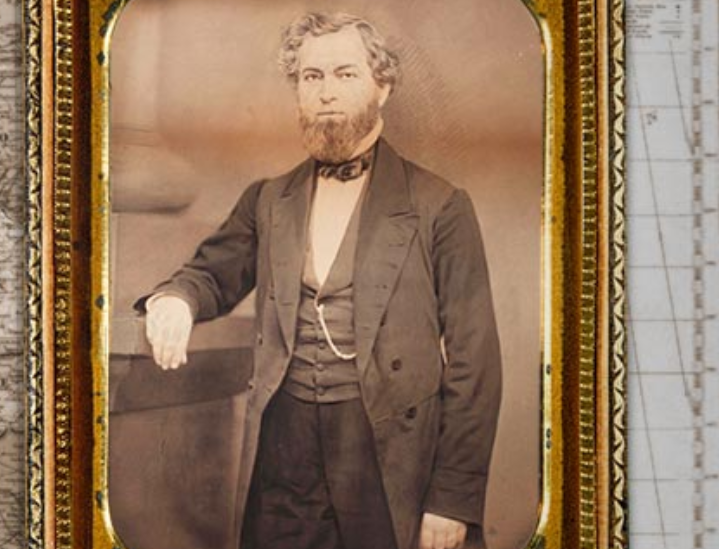

Wells was born on December 12, 1805 into a family of priests in Seaford, Vermont, and is the third son of itinerant priests Shipley Wells and Dolly Randall Wells. Before becoming a banking and insurance giant, Wells first became an apprentice tailor and shoemaker at the age of 16.
One of the biggest challenges he faced in his early days was overcoming severe stuttering. In 1824, Wells visited a speech therapist in Rochester, New York. After learning from therapists and integrating his own methods, Wells traveled to several cities to help other people with language disabilities.
Despite his best efforts, his stuttering remains severe. “I’ve healed everyone except myself,” Wells later joked. However, his difficulties in speaking never prevented him from making friends and his energy, eccentricity and friendship became the cornerstone of many of his commercial efforts.
The newspaper cut-out read: “Cure the stuttering.” In our advertising column, we will find a new and comprehensive approach by Henry Wells to dealing with language disorder ads. Mr. Wells himself has been plagued by stuttering since his youth and has tried all the systems in his own experience: the true philosophical induction of bacon. We recommend that those suffering from this problem try to ask for help from Mr. Wells. An article that reports on how Professor Henry Wells taught those who have language barriers like him. Source: Herald, New York, January 14, 1836.
William G. Fago
Fago was born on May 20, 1818 in Pompeii, New York, the eldest of 12 children of William C. Fargo and Tracy Strong Fargo. As a child, he helped his father work on the farm in the summer and went to school in the winter. When he was 13, the local postal contractor hired him to transport mail 43 miles around Pompeii.
In his adult life, Fargo’s commercial investments included many railway companies, making him Director of North Pacific Railway. His railroad investment has left a lasting legacy in many cities, including the beech town, North Dakota, that bears his name.
Fago has also invested in businesses in many railway cities. He became one of the original shareholders of the Northwest National bank, founded in Minneapolis in 1872, and then the bank merged with Wells Fargo in 1998 to become norwest.
The Beginning of an Industry
In 1841, William Harden, the nation’s first express courier, hired Wells to find a solution to the needs of those in need of a courier service between New York City and Albany, New York State. For those who can’t afford that option, they deliver valuable packages and letters to train wagon drivers, railroad workers or steamship crews and expect the best results. Full-time Express couriers such as Wells offer an affordable and secure alternative to paying for multiple clients.
Illustration of street scenes in New York City in 1828. On the dock mast of several large sailboats, on the right are brick buildings. There are busy people working in the middle of the street.
Pier near Madison Street in New York City, 1828. Before the courier company appears, people will gather at the dock in search of friends willing to deliver.
After working with clients and knowing their business needs, Wells told Harden that there is a demand for service expansion to West Buffalo, Chicago, and St. Louis in New York State. Harden responded unexpectedly: “If you choose to drive express to the Rocky Mountains, you’d better do it yourself; I choose to drive express where there’s business.”
At the time, the journey from Albany to Buffalo required several train lines, which ran in three days and four nights. For 18 months, Wells spent 18 of the 21 days on the road, his trunk filled with money and valuables, while his suitcase was filled with all kinds of strange packages.
View of the unpaved street, with garages in front and smaller buildings in the distance. Painting in black and white. Click the image link to enlarge the image.
In 1841, a train car departed Buffalo, New York. Henry Wells traveled on this train to Buffalo in the early 1840s to deliver packages and cash to his customers.
One of his most memorable memories in the early days of opening his business was the success in shipping fresh oysters to buffalo. As Wells later described, local residents gathered around him when his delivery “caused almost the same excitement as when the locomotive first crossed the United States.”
He also reminded bankers and merchants who depend on him to pay. This is the first time that “people who are not known beyond their names” can do business remotely because they believe Wells can transport their money “risk-free and at a very low cost.”
Wells Fargo collaborates with Citigroup
In 1845, Wells worked with Fargo to hire him as a courier, extending his courier service to Cleveland, Chicago, and other Midwest regions. Fargordon boarded the train and steam to transport packages, documents and cash, including a regular eight-day trip from Buffalo to Detroit. Fargo took advantage of the experience to then establish businesses in his name and hire his own Messengers.
The black and white advertisement shows that the gold powder has been shipped to the Atlantic countries and delivered safely. Click the image link to enlarge the image.
In an advertisement from the 1850s, when Wells Fargo began connecting homes and businesses from the Pacific to the Atlantic. In 1850, Wells, Fargo and other couriers who worked with them merged many of their businesses and founded American Express. The company has created a huge network of couriers and offices serving its customers across the East Coast and Midwest. At the same time, news of gold mines discovered in California triggered the largest wave of migration in U.S. history as people go in search of their wealth. For the first time, reliable transoceanic communication, freight and payment services are needed.
A color map of the United States from 1852, depicted in pink, yellow, and green. Much of the west is marked as territory because they have not yet become states.
Map of the United States, 1852. That same year, to connect coastal families and businesses with the coast, Wells, Fargo & Co. was founded.
In 1852, Wells and Fargo went to the American Express Board of Directors and proposed expanding their business to meet the needs of Pacific Coast customers. Most of the directors rejected his proposal, so Wells and Fargo decided to create their own company: Wells, Fargo and United.
A few years later
After starting the company, Wells and Fargo served as members of the Board of Directors. Throughout their lives, they always associate with Wells Fargo when they appear at events or are quoted in time in the newspapers. Wells was a member of the Board of Directors from 1852 to 1866. Fargo served on the Board from 1852 until his death in 1881. He was also President of Wells Fargo from 1870 to 1872 and President of American Express from 1868 to 1881.
The women in long skirts stood on the lawn next to the building outside University Wells. Henry Wells founded Wells College in 1868. More than a decade after founding Wells Fargo & Co., Henry Wells fulfilled his lifelong dream: to create a college for women. She donated her fortune to Wells College in Aurora, New York, one of the first institutions of higher education for women in the United States. Three years before his death, in 1875, he declared in his speech at the university: “Let us remember that the value of our lives is not in how many years and days we exist, but in what we have achieved in our lives and in what we can do well for our neighbors.”
During the war, officers from New York’s 164th Infantry Corps stood on the battlefield armed. This is a historical black and white photo.
Officer of the 164th New York Infantry Corps in the 1960s. William Fargo was the mayor of Buffalo during the war and was known as the “friend of the soldiers” for supporting the soldiers in various ways. Photo source: Library of Congress.
As for the beech, he was mayor of Buffalo twice during the Civil War. “It is not easy to go back to the details of municipal affairs at a time when the country is in danger and on trial, when everyone feels or should feel the need to contribute all their strength to the government. provide the regiment’s flag to a local regiment and help the federal army in 1864 avoid conspiracies planned by the Confederacy to invade Buffalo and other Lake Erie cities.
Today, Wells Fargo continues to follow in the footsteps of its founders, adapting to the changing needs of the world and seeking innovative solutions to help clients succeed financially.
-

Our Story: A Partnership Born to Meet Challenges
In March 1852, Henry Wells and William G. Fargo founded Wells and Fargo. As in the early days of ...